

What ATP testing actually measures
ATP testing checks for residual organic matter left on a surface after cleaning — it does not identify what species, if any, is present on it. The chemistry works by bioluminescence: a reagent reacts with any ATP recovered from a swab, and a luminometer reports the light produced as relative light units (RLU). More residue on a surface generally means a brighter reading.
That distinction matters. A clean-looking surface can still carry ATP, and a low ATP reading says nothing about which organisms are or are not present. ATP testing is a cleaning-verification tool, not a microbiological test — it tells a QA team whether a surface was adequately cleaned before the next production run, not whether that surface is free of a specific pathogen. Treating an ATP pass as equivalent to a micro pass asks the method to do something it was never built to do.
Why ATP + ADP + AMP matters
Standard ATP-only chemistry has a known blind spot: cooking, heat treatment and processing break ATP down faster than they break down ADP and AMP, the two related energy-carrying molecules a cell also holds. On surfaces that see cooked, heat-treated or processed product — grills, ovens, filling lines, pasteurisers — an ATP-only swab can under-report residue that is still genuinely there, because the ATP portion of it has already degraded by the time the swab is taken.
The A3 method used in Kikkoman's LuciPac A3 swabs measures ATP, ADP and AMP together, converting all three back to a common signal before the read. That recovers residue an ATP-only test would miss on exactly the surfaces where cooked or processed product is most likely to leave it behind.
The ten-second workflow
The method is built to fit inside a production changeover, not interrupt it. Swab the surface, insert the swab into the Lumitester, and read the result in RLU roughly ten seconds later. There is no incubation step and no separate reader to walk to — the swab and the reagent are self-contained, and the Lumitester handles the read.
That speed is the practical advantage over a traditional swab-and-plate hygiene check, which needs an incubation period before a result is available — useful for confirming what grew, but too slow to inform a decision before the next shift starts. ATP testing is not a replacement for that culture-based check; it answers a narrower, faster question at the point cleaning verification actually needs one: is this surface ready to run again, right now.
The instrument: Kikkoman Lumitester Smart
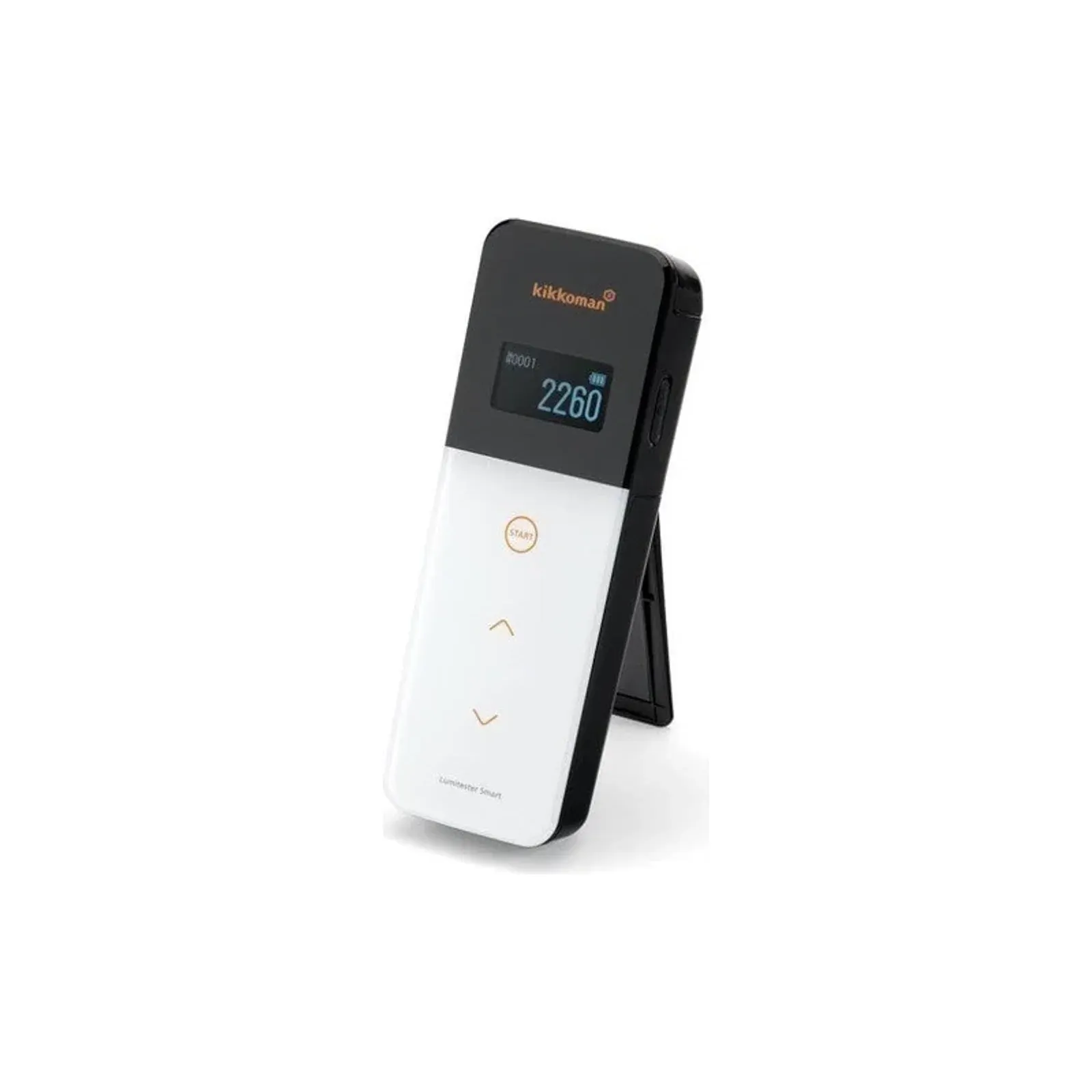
The Kikkoman Lumitester Smart is the handheld luminometer that reads LuciPac A3 swabs and reports the RLU result. It runs on 2 x AA batteries (alkaline or NiMH), measures 65 x 175 x 32 mm and weighs 255 g — small enough to carry on a walk-through. Results sync to the Lumitester app, which keeps a running record by test point, line and site rather than a single reading in isolation, which matters once a team is tracking trends rather than one-off checks.
For a site running more than one production line, or an operator with several facilities, that cloud-synced record is what turns individual swab readings into a monitoring programme: the same test point over time, compared across lines, or rolled up across sites for whoever owns hygiene sign-off. A single reading tells you about one moment; the logged history is what tells you whether a line is trending in the wrong direction before it becomes a failure.
Request a quote for the Lumitester Smart
The swab: LuciPac A3 Surface
LuciPac A3 Surface is the self-contained swab the Lumitester Smart reads: the releasing and luminescent reagents are held inside the swab body, so there is nothing to prepare separately before use. It ships 100 swabs to a box, packed in 20 aluminium bags of five, with a 15-month shelf life from manufacture.
The A3 Surface swab carries AOAC Performance Tested Method (AOAC PTM) certification — a validation specific to this swab and the matrix and organism combinations it was studied against, not a blanket claim about the method in general. For water-line testing, Kikkoman also makes a LuciPac A3 Water swab built for liquid samples rather than surfaces.
Request a quote for LuciPac A3 Surface swabs
Where ATP fits in a monitoring programme
ATP testing works alongside microbiological testing, not instead of it. A hygiene programme that only ever checks ATP has no way to confirm which organisms are actually present when a reading is high, and a programme that only runs periodic micro testing has no way to catch a cleaning failure between sampling dates. Used together, ATP testing catches day-to-day cleaning gaps and micro testing confirms what is actually growing when it matters.
A single RLU reading is also less informative than a trend. The same swab point read every shift, every day, builds a baseline for what "normal" looks like at that specific location — and a reading well outside that baseline is a more useful trigger for action than any fixed number could be on its own.
What to decide before you buy
Before bringing ATP testing into a facility, it is worth settling three things in-house: how many test points and sites need covering, who reviews the results and acts on them, and where the internal pass/fail threshold gets set for each surface. Tamooh does not publish a universal RLU threshold, because the right number depends on the surface, the product and the baseline a facility builds for itself — not on a figure lifted from a spec sheet.
Get in touch to talk through a monitoring setup for your sites, or request a quote directly for the Lumitester Smart or LuciPac A3 Surface swabs.